Sailboat Metaphor
Turn a strengths report into a coaching conversation clients remember — a whiteboard journey across eight zones of a sailboat, from goals and strengths to the circumstances you can't control.
Quick Facts
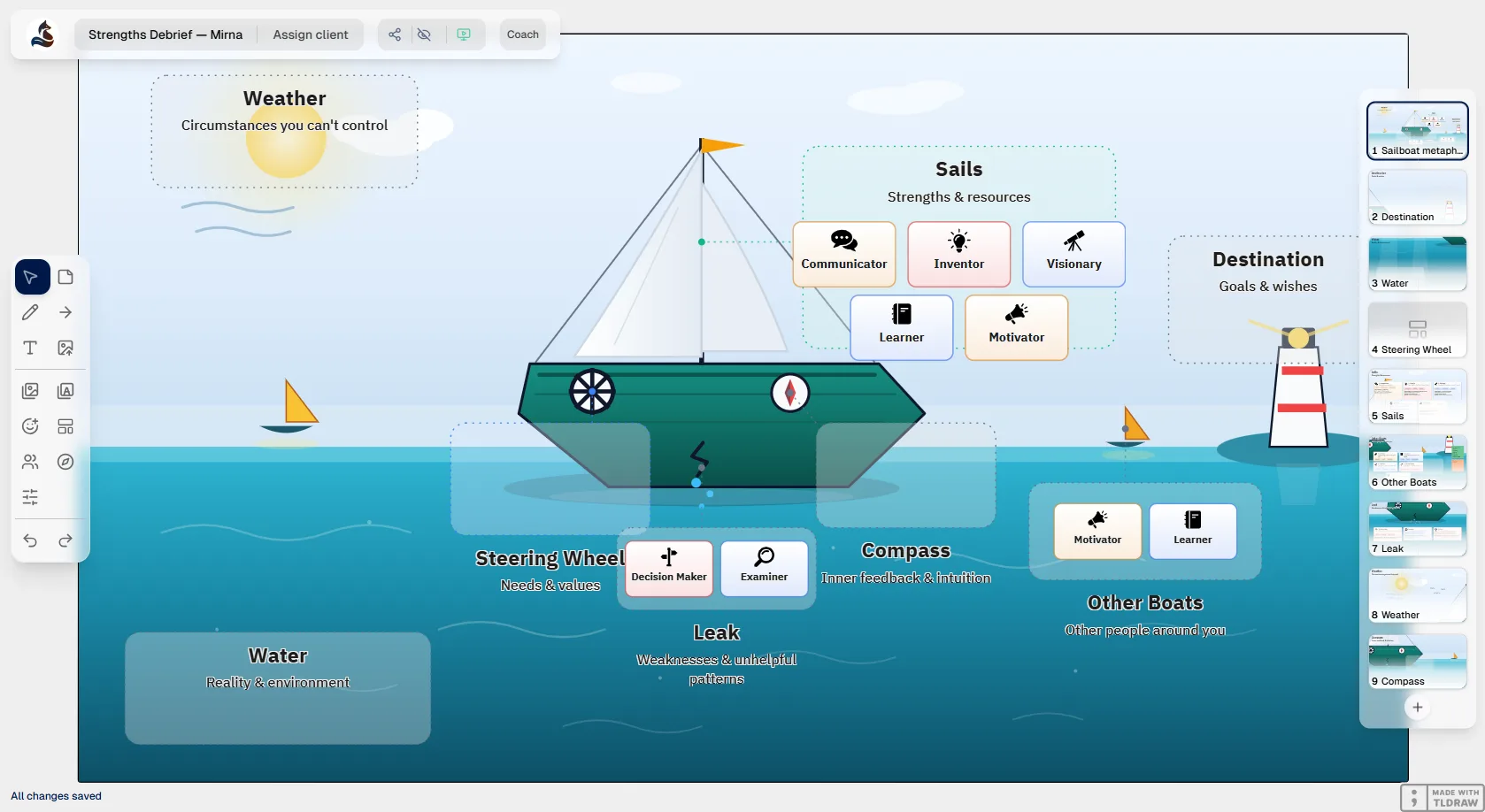
- Eight zones on one boat: five internal (Sails, Leak, Destination, Steering Wheel, Compass) above the waterline, three external (Water, Other Boats, Weather) below it.
- The core move: patch the big leaks, then put most of your focus on the sails — your strengths propel you forward and give you energy.
- Built to debrief a Strengths Discovery result on the whiteboard — signature strengths become the sails, unhelpful patterns the leak, outside feedback the other boats.
- Use it three ways: as a single memorable image, as a linear journey, or by starting anywhere and following what emerges.
- Works for one-on-one coaching and group facilitation alike — one boat, or a whole fleet for a team.
Give someone the research on strengths — more energy, faster learning, more positive emotion — and it tends to slide right off. Show them a sailboat, and it sticks. That is the whole point of the sailboat metaphor: one picture that turns an abstract strengths report into a conversation people actually remember.
The boat is you — or a team, or an organisation. Its sails are your strengths: open them and you move fast, and you enjoy the ride. Its hull has leaks — weaknesses and unhelpful patterns you can bail out forever. In any moment you can obsess over the leaks or trim the sails. The message isn't "ignore the leaks" — a real hole needs patching — but where does the majority of your attention go? On metaFox, the metaphor is now a ready-made way to debrief a Strengths Discovery result, right on the whiteboard.
The eight parts of the boat
The elements split into two worlds. The five above the waterline are internal — things about you that you can shape. The three below are external — the sea around you, which you meet rather than control.
Above the waterline — your inner world
Sails — Strengths & resources
What propels you forward: your signature strengths, plus external resources and effective ways of coping. The part to lean into.
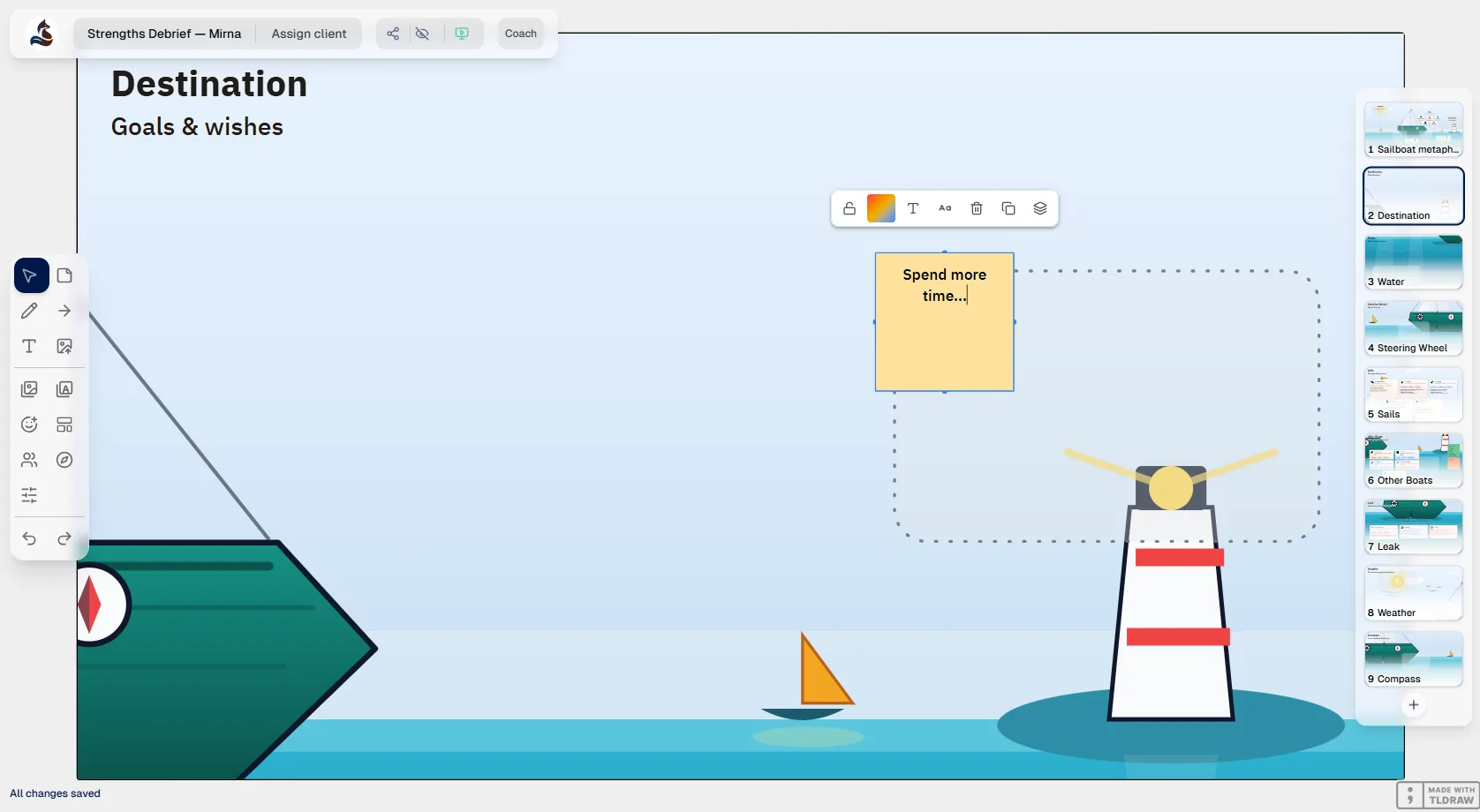
Destination — Goals & wishes
Where you are heading and why the journey matters — the goals and aspirations that give the trip a direction.
Steering Wheel — Needs & values
What you steer by: the needs and values that set a meaningful course before you pick a specific goal.
Compass — Inner feedback & intuition
Your gut read on whether you are still on course — feelings, intuition, the quiet inner feedback that is easy to talk over.
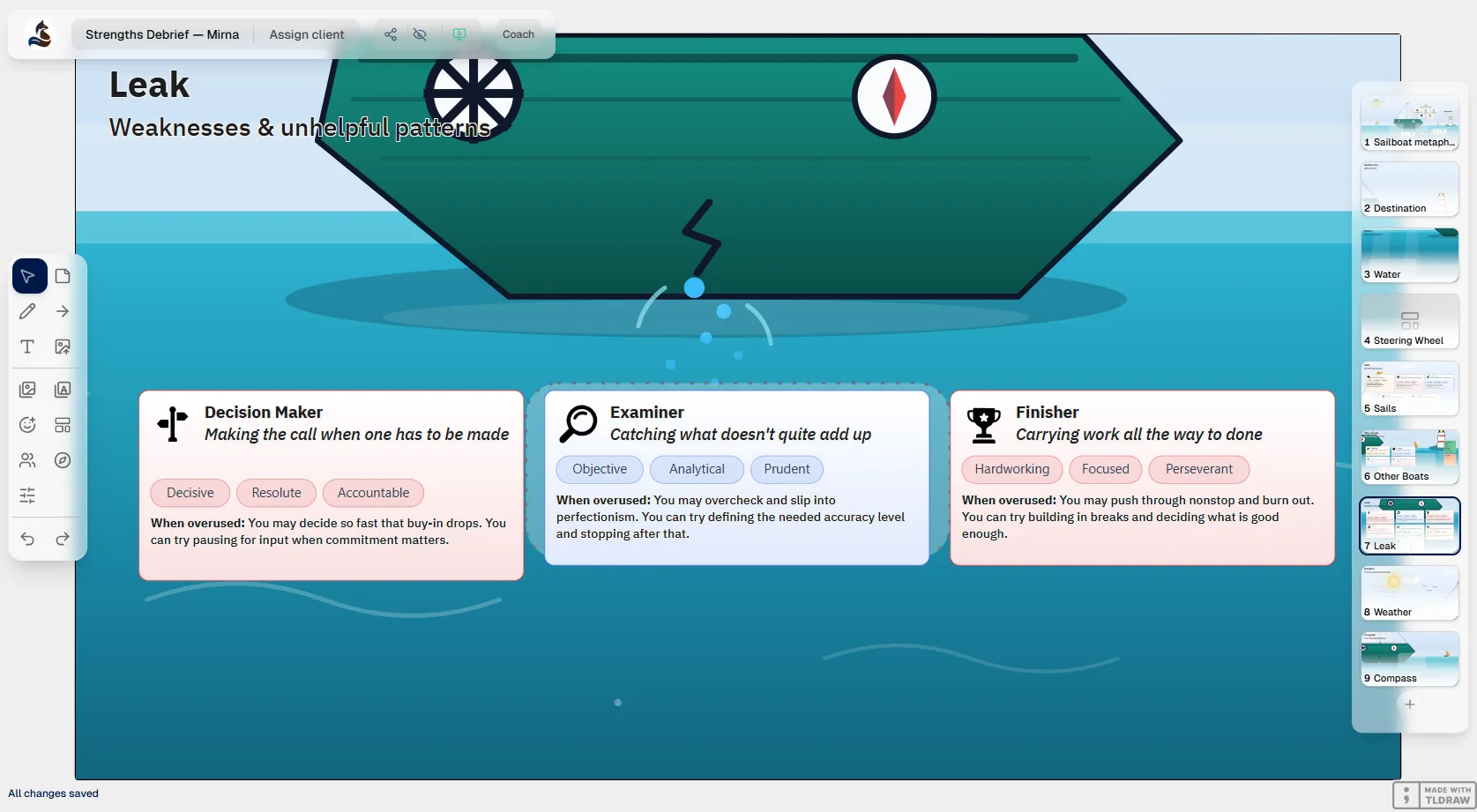
Leak — Weaknesses & patterns
Weaknesses and unhelpful patterns — overused strengths and learned, draining behaviours belong here too. Name them without dwelling.
Below the waterline — the world around you
Water — Reality & environment
The conditions you are actually sailing in right now: the real situation and environment around the boat.
Other Boats — Other people
Peers, teammates, the people around you. Work with a whole fleet when you run this with a team.
Weather — Out of your control
Luck, storms, a good wind — the circumstances you can't control. This is the resilience conversation: what is, and isn't, up to you.
The core idea: sails over leaks
Patch the big holes, then trim the sails
Every boat takes on water — you will never fix every leak, and new ones keep appearing. Engaging the sails is energising and it actually moves you. So patch the holes big enough to stay afloat, then put most of your focus on the sails. You will be happier, more energised, and you will get better results.
This is the heart of a strengths-based approach: not denial of what's hard, but a deliberate choice about where attention goes. Acknowledge the leaks, name the weaknesses — then spend the bulk of the session on what already works and where it can take the client.
Three ways to use it
You don't have to run all eight zones in order. Facilitators tend to use the metaphor at one of three levels:
As a single image
Share the boat as one sticky picture before or after a strengths conversation. It makes the ideas memorable and lowers resistance to "looking at the positive."
As a full journey
Walk zone by zone — destination, sails, leaks, weather — as a whole session or even a multi-part course. Thorough, but rarely necessary.
Start anywhere, follow what emerges
How most facilitators actually work: begin with sails and leaks, or with goals, and let the relevant zones surface. Own it, adapt it, and drop the parts that don't resonate.
How to run it on metaFox
The sailboat is one of two ways to debrief a Strengths Discovery result on the whiteboard (the other is a linear report breakdown).
Run a Strengths Discovery
Invite your client to the science-based assessment. They score what gives them energy and how often they use it, and can invite others for an outside view.
Open the result
You and your client can review the signature strengths, the unrealized strengths (the hidden gems worth bringing out), and the energy-draining learned behaviours — in the app or as a PDF.
Start the debrief and pick the sailboat
On the result, choose "Start strengths debrief," then select the Sailboat metaphor. The report lands on the boat instead of a page.
Work the boards
Signature strengths fill the sails, unhelpful patterns the leak, outside feedback the other boats. Move things around, add sticky notes, bring in other tools like strengths cards, and zoom into each zone on its own board.
Facilitation prompts, zone by zone
When you do dive into a zone, treat it like any good coaching conversation — the boat just gives it a shared picture.
Destination
Work backwards from an ideal future. Warm up with a dreamy exercise — an ideal day, the "rocking chair" at ninety, a funeral speech — before anyone commits to a goal. Then move lifetime, three years, this year. Three years is a sweet spot: far enough to think big, near enough to stay connected.
Sails
Which strengths will help reach that destination? Name them, claim the vocabulary, and decide together what to tune up.
Weather
The ultimate resilience question: what is outside your control, what is inside it, and what will you do about the part that is? Watch for things wrongly filed as "weather" that are actually within reach.
Other Boats
Who is in your fleet? Which relationships and external resources can you draw support from — in emotion and in action?
Go deeper — the conversation behind the tool
The sailboat metaphor comes to metaFox by way of facilitator Mirna Smidt (Trainers Toolbox / Happiness Academy). In this episode she and metaFox founder Tobi unpack strengths psychology, walk all eight zones, and talk through how to run the journey with both groups and individuals. Mirna also covers the metaphor solo on her own Trainers Toolbox podcast.
Origins & further reading
The short version of the metaphor — sails versus leaks — traces back to Robert Biswas-Diener; the elaborated eight-element boat was developed by positive-psychology researcher Hugo Alberts in 2016. The facilitation approach here draws on Mirna Smidt's work.
- Pair the debrief with the Strengths Discovery assessment — the report that fills the sails.
- The Sailboat metaphor ships as a ready-made session template: open a new session, pick it from the template library, and the overview board plus one board per zone are set up for you.