Wheel of Life
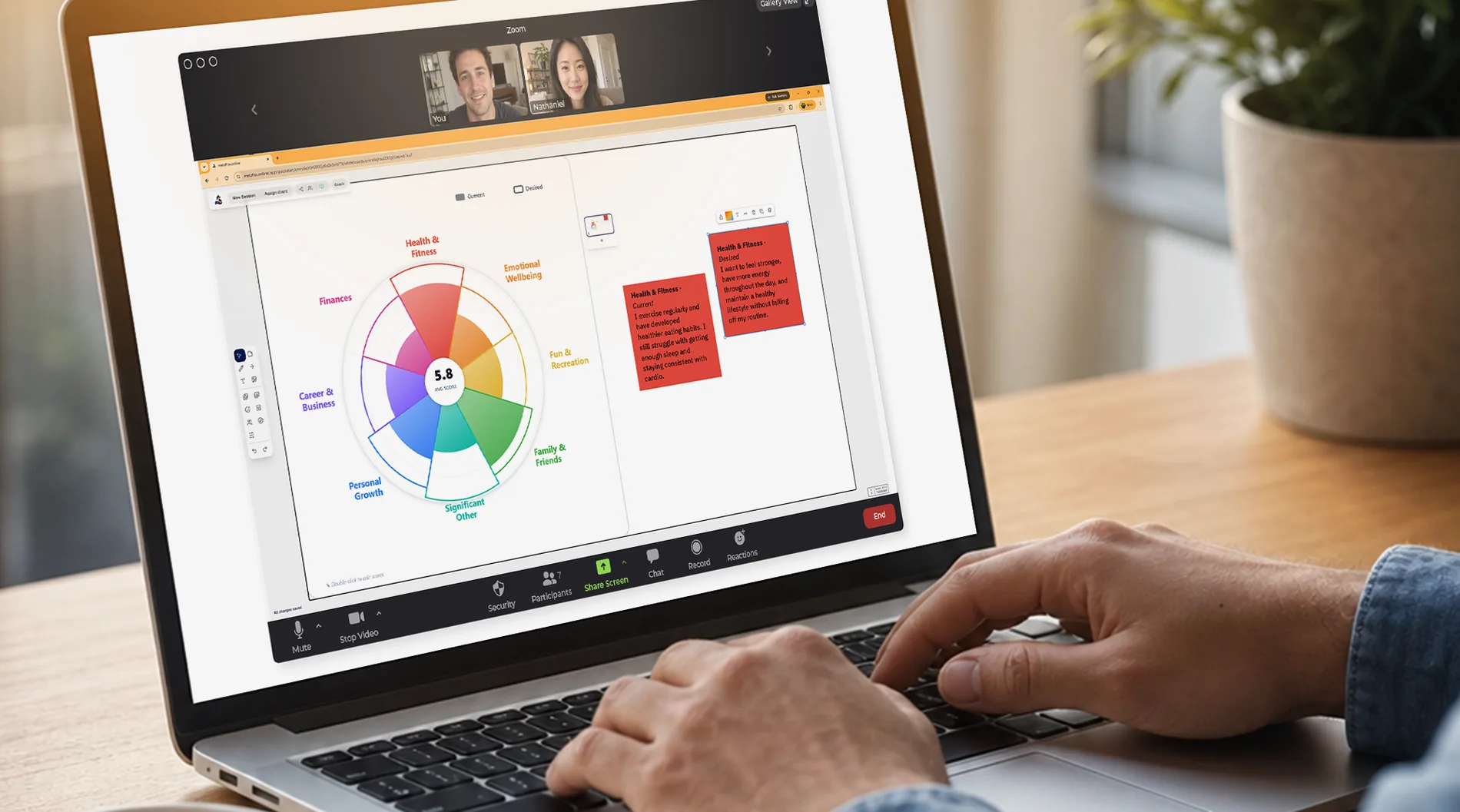
The classic life-balance assessment — clients score their satisfaction across eight life areas directly on a shared wheel.
Quick Facts
- 8 life areas by default (Health & Fitness, Career & Business, Finances, …) — rename any area inline to fit your client.
- The wheel is the input: clicking inside a slice sets that area's score — inner edge = low, outer edge = high.
- Two layers: Current (where I am today) and an optional Desired overlay (where I want to be) — the gap between them is the coaching conversation.
- Per-area comments land on the whiteboard as color-matched sticky notes, synced both ways.
- A classic for the start of a coaching journey — run it again later and compare wheels to make progress visible.
The coaching classic for a comprehensive look at your client's life situation: fill out the wheel together, keep talking right on the board, and everything stays documented. A typical session follows a simple arc:
How to use this tool
Launch the wheel from the whiteboard toolbar
In a live session, click "Wheel of Life" — the tool finds or creates the wheel for this session, and your client's view opens automatically. Everything that follows is live-synced in both directions.
Client scores by clicking the wheel
The wheel itself is the only input: clicking inside a slice sets that area's score by distance from the center. The progress bar tracks coverage, and a comment field below captures the "why this score?" for the selected area.
Add the Desired layer
Once the current state is mapped, switch the toggle from "Current" to "Desired" and let your client mark where they want to be. The target renders as the same slice grown to the target ring — the visual gap between today and target is where the coaching conversation lives.
Finish and work on the board
"Done" drops the wheel onto the whiteboard as an image, with every comment as a color-matched sticky note beside it. Notes stay editable and sync back to the wheel; double-click the wheel image any time to re-open and update it in place.
The tool adapts to your practice: rename areas inline to match your client's world (your customized wheel is saved for you; the platform default stays intact), run multiple wheels within one coaching relationship to re-assess over time, and let clients re-open their wheel on their own via their toolbar. From the Wheel of Life library you can also create share links — clients or prospects fill out a wheel asynchronously in the browser, no login required.
The eight life areas
The classic wheel ships with eight areas, each with its own color on the board:
Health & Fitness
Physical wellbeing, energy, fitness, sleep, and overall vitality.
Emotional Wellbeing
The inner life: emotional balance, resilience, and peace of mind.
Fun & Recreation
Hobbies, play, leisure; how much joy and lightness life holds.
Family & Friends
Quality of close relationships with family members and friends.
Significant Other
The romantic or partner relationship: intimacy, connection, shared growth.
Personal Growth
Learning, self-development, progress toward who the client wants to become.
Career & Business
Work, profession or business, and how fulfilling and values-aligned it feels.
Finances
The relationship with money: income, savings, financial security.
None of this is fixed: areas can be renamed inline to fit the person in front of you — a leadership wheel, a team-health wheel, a semester wheel — and frameworks support 6, 8, 10 or 12 segments.
Psychological grounding
The Wheel of Life is one of the most widely used instruments in coaching, commonly attributed to Paul J. Meyer in the 1960s. Its power lies in making a subjective landscape visible: clients rate their satisfaction with each life area — not their objective circumstances — and the filled wheel shows at a glance where they thrive and where they struggle. That visual overview is hard to reach through conversation alone, which tends to stay inside the one or two areas that are currently loud.
The gap between Current and Desired is the conversation
Not every area needs to become a 10. The comparison between the two layers turns a static snapshot into direction — and clients often discover that a modest gap in one area matters more to them than a large gap in another. Where the gaps are chosen, goals follow naturally.
Two design principles matter when facilitating. First, the scores are self-assessments: a "4" in Finances says how the client feels about money, and the interesting material is usually the reasoning behind the number — which is why every area invites a comment. Second, the comparison between the Current and Desired layers turns a static snapshot into direction: clients weigh which gaps matter most to them.
Used at the beginning of a coaching journey, the wheel doubles as an agenda-setter — the areas with the biggest felt gaps are candidates for the work ahead. Revisited after some months with a fresh wheel, it becomes a progress record: two wheels side by side show movement that day-to-day life makes easy to overlook.
Further reading
The Wheel of Life is widely used in coaching (its origin is often attributed to Paul J. Meyer in the 1960s, though without a verifiable primary source). Its academic grounding lies in the measurement of life satisfaction:
- Diener, E., Emmons, R. A., Larsen, R. J., & Griffin, S. (1985). The Satisfaction With Life Scale — the validated instrument for global life satisfaction, the concept the wheel makes visual.
- Swami, V., et al. (2025). Life satisfaction around the world: measurement invariance of the SWLS across 65 nations. PLOS ONE — recent large-scale evidence that satisfaction ratings are cross-culturally robust (open access).