Picture Cards
Prompt reflection and conversation with the metaFox deep pictures — images that reach where words alone don't.
Quick Facts
- Curated deep pictures sets for different contexts — ORIGINAL (the all-rounder), Design Your Life (goals), Growing Together (teams), World of Emotions (pleasant *and* unpleasant feelings), Dreamland, Gallery of Emotions.
- Most picture-card exercises follow 3 steps: prompt question → each participant chooses a card → conversation about what it shows.
- Images trigger an almost instant emotional response — they bypass the "cognitive guardians" and reach the core of a topic faster than words.
- The prompt question steers everything: "Which picture describes how you are here today?" makes the method fit any part of the journey.
- Safe distance: it is easier to talk about "the stone in the picture" than "my heavy burden" — externalizing makes problems workable.
The deep pictures reach where words alone don't. Most picture-card exercises follow a simple three-step flow:
How to use this tool
Open the tool
Launch the Picture Cards tool directly from your dashboard or within an active whiteboard session.
Select a card set
Choose from the metaFox deep pictures sets: positive metaphors for icebreakers, "World of Emotions" when you want to explore darker themes, or abstract illustrations for a fresh approach.
Ask a prompt question
Define a guiding question — "Which card represents your current block?", "Which picture describes your ideal outcome?" — and open the space for intuition. The prompt is what makes the method so versatile: it fits check-ins, goal work and everything in between.
Client selects
Your client browses and selects a card privately on their own device, at their own pace. Once ready, the card appears on the shared whiteboard.
Facilitate deep reflection
View the image together and use it as a visual anchor. The art of going deeper is mostly asking about the picture itself: "What shapes and colors do you see?", "Which detail catches your eye?", "What do you think is missing?"
These are just starting points. You can work with random cards, have participants choose images for each other, or run the classic three-step group flow — prompt question, card choice, conversation. Your creativity as a coach is the only limit.
Choosing a card set
The deep pictures collections are curated, not licensed image stock: every set is designed for specific systemic and psychological interventions. Match the set to the emotional range you want to open up.
deep pictures ORIGINAL
The classic all-rounder: high-association images that open up almost any topic. Perfect to start with — check-ins, warm-ups and personal-growth work.
deep pictures World of Emotions
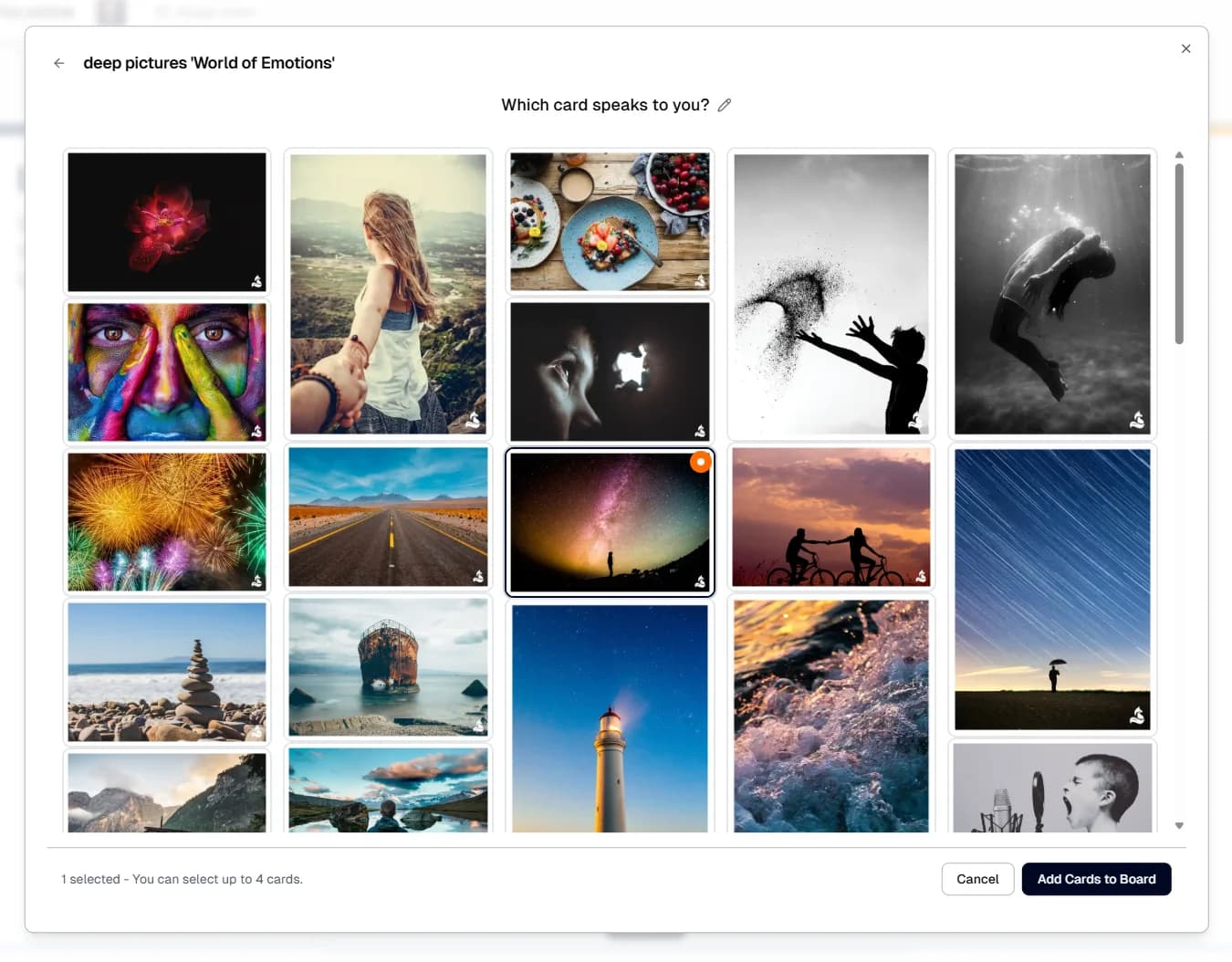
Built for feeling work, with pleasantly and unpleasantly associable images. Use it to trigger pleasant AND unpleasant emotions — describing roadblocks, obstacles or distressing memories.
deep pictures Design Your Life
A playful life-design process in three steps — Discover, Design, Develop. Ideal for goal work, decisions at a crossroads, and life or career transitions.
deep pictures Growing Together
Group dynamics, growth and systemic constellations; ideal for team coaching, peer feedback and workshops.
deep pictures Dreamland
Dreams, aspirations and the ideal self across life stages. A resource-oriented set for motivation work and positive warm-ups.
deep pictures Gallery of Emotions
Abstract, image-only illustrations — no printed questions. Free association around emotions for a fresh, contemplative approach.
World of Emotions reaches the hard feelings too
Unlike sets built on positive imagery, World of Emotions deliberately includes unpleasantly associable images. Choose it when you want to evoke strong unpleasant emotions — and you and your client are ready to work with what comes up. Its strength: a client can point to the picture that matches anger, grief or fear without having to put it into words first. For a light check-in or a positive warm-up, reach for ORIGINAL or Dreamland instead.
Psychological grounding
Visual imagery taps into emotions and thoughts in ways words alone often cannot. Where words require cognitive processing, images trigger an almost instant emotional response — which is why picture work bypasses the "cognitive guardians" and reaches the core of a topic faster. Pictures engage multiple senses and deep associations, they cross language and culture barriers, and they invite metaphorical thinking: clients project inner material onto the image, which sidesteps defenses and reveals what lies beneath the surface. Along the way, images simplify complex ideas, spark new thinking when a client is stuck in circular loops, and help insights stick in memory after the session.
Safe distance makes problems workable
It is easier to talk about "the stone in the picture" than "my heavy burden." Externalizing a burden onto the image provides the emotional room needed for honest self-reflection — the indirectness is what lets a client open up.
This practice has a long lineage. Freud read symbolic imagery in dreams; Jung brought mandalas and symbolic drawing into therapy. The mid-20th century added projective techniques — the Rorschach inkblots, the Thematic Apperception Test — using visual stimuli to surface unconscious thoughts, while art therapy (Naumburg, Kramer) gave clients who struggled with words a creative channel. Cognitive-behavioral approaches later adopted guided imagery and visualization for reframing. Digital picture cards continue that tradition with the same core principles.
Roland Barthes' concepts of studium and punctum explain how a single card can work on two levels: studium is the general, intellectual engagement with an image — what it depicts, what it says culturally — while punctum is the unexpected personal detail that pierces, connecting the viewer to their own memories and emotions. A rich session uses both: emotional engagement through the punctum, analytic reflection through the studium. The deep pictures are curated with exactly this in mind — each image passes multiple reviewers so that no single curator's punctum bias narrows the set, giving every participant the chance to find the picture that speaks to them.
Further reading
- Lindzey, G. (1959). On the Classification of Projective Techniques. Psychological Bulletin — the classic account of how people project meaning onto an evocative stimulus.
- Projective Methods — an accessible overview of projective techniques and the projective hypothesis.
- Storch, M., Krause, F., & Weber, J. (2022). Selbstmanagement – ressourcenorientiert (Zürcher Ressourcen Modell, ZRM®). Hogrefe — the ZRM®, whose picture cards activate personal resources (German).