Inner Team
Map inner voices as team-member figures on the whiteboard and guide clients from inner conflict to self-leadership — based on Schulz von Thun's Inner Team model.
Quick Facts
- 20 predefined team-member figures — from the Leader and the Sage to the Critic, the Worrier, and the Rebel.
- Based on Friedemann Schulz von Thun's Inner Team model (1998): our inner plurality works like a team with a team leader.
- Session arc: explore the topic → client selects team members → every voice gets a say → dialogue and integration.
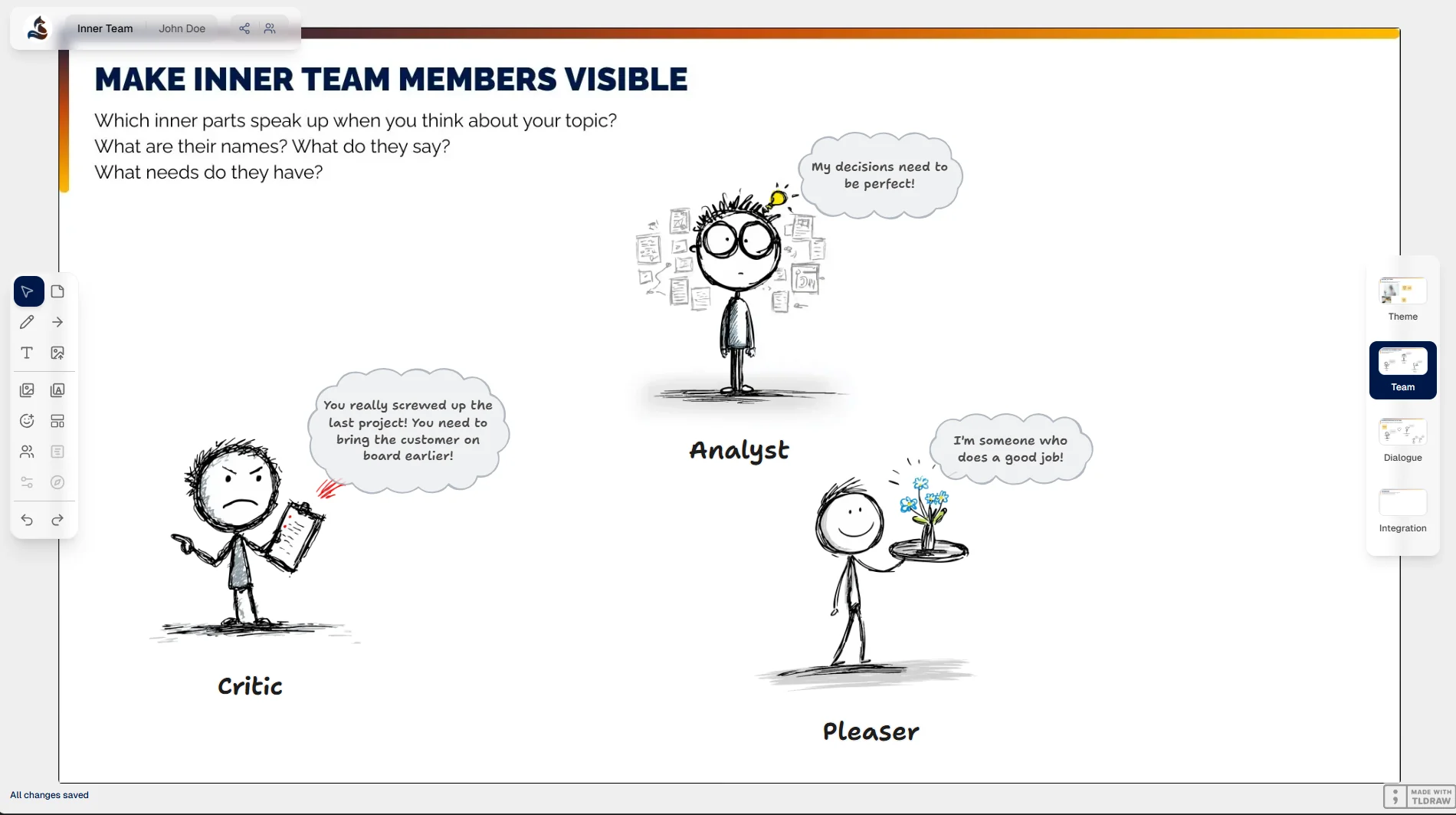
- Each figure lands on the whiteboard with a name label and a speech bubble, arranged in a circle ready for dialogue.
- The goal is never to silence a voice but self-leadership — every part gets its rightful place.
The Inner Team makes inner voices visible, lets them speak, and guides your client toward a shared direction — all on one shared board. A typical session follows a simple arc:
How to use this tool
Open the Inner Team tool
When your client feels stuck, conflicted, or unable to decide — when inner voices pull in different directions — open the Inner Team tool from the whiteboard toolbar and pick a figure set. It brings a cast of predefined team-member figures, so the inner landscape takes shape without anyone having to draw.
Frame the exercise
Set the guiding question ("When you think about this topic, what different voices do you notice within you?"), choose how many team members your client may select, and decide whether figure names and descriptions are shown — hide the names when you want clients to name their voices themselves. Then start the experience; clients on the board are invited automatically.
Client selects team members
Your client browses the figures and picks the ones that resonate with the voices responding to their topic. The inner Leader is preselected as the team's moderator, and you see selections appear live while your client chooses.
Give every voice a say
The selected figures land on the whiteboard arranged in a circle, each with a name label and an empty speech bubble. Fill each bubble with what that voice wants to say, move figures closer together or further apart, and facilitate the dialogue toward integration.
For the coaching conversation itself, work in three movements: Explore the topic (invite your client to pause — what occupies them, and which sides within them respond to it?), Make the parts visible (each voice gets a name that captures its character, a place on the board, and its say: what does it want, what does it need?), and Dialogue & integration (what would the parts say to each other, where are commonalities and tensions, and which shared direction honors every voice?). A powerful closing question: "What changes when every voice has its place — and how can you move forward with all of them on board?"
The team-member figures
The starter set holds 20 figures covering the cast most clients recognize immediately. Broadly, it spans six groupings:
Leading and integrating
The Leader, a wise integrator who coordinates the inner voices with clarity. It is preselected by default and placed at the top of the circle: the seat of your client's conscious self.
Wise and grounded
The Sage (sees the bigger picture calmly), the Analyst (logic and perspective), the Bodily Voice (senses needs through tension and ease), and the Resting Self (calm for body and mind).
Caring and connecting
The Care-Taker (invites rest and compassion), the Peacemaker (bridges conflicts with empathy), and the Cheerleader (celebrates strengths and wins).
Driving and exploring
The Adventurer (seeks novelty and growth), the Dreamer (envisions new possibilities), the Rebel (protects authenticity and freedom), and the Performer (seeks success and pushes forward).
Protecting and warning
The Worrier (anticipates danger), the Defender (sets boundaries), the Critic (points out flaws), the Perfectionist (seeks control through perfection), and the Pleaser (adapts to avoid rejection).
Quiet and vulnerable
The Child (open-hearted core), the Outcast (feels rejected, hides wounded parts), and the Shadow Self (holds repressed power and raw energy).
These groupings are informal orientation, not a fixed taxonomy — in Schulz von Thun's language, clients will discover their core players, their quiet voices carrying important messages, and their inner antagonists among them. And because you can hide names and descriptions, the same figures also work as blank characters your client names in their own words.
Psychological grounding
Friedemann Schulz von Thun, one of Germany's most influential communication psychologists, developed the Inner Team model in 1998. It uses the metaphor of a team with a team leader to describe our inner plurality: when we face a decision or conflict, we can listen inward and discover different team members — core players that define how we show up, quiet voices that carry important messages, and inner antagonists that create tension. The team leader — our conscious self — can learn to moderate these voices, giving each one a hearing while holding direction. Schulz von Thun's key insight: inner dynamics mirror real-world team dynamics, and when we lead our inner team well, our outer communication becomes more authentic and effective.
The goal is self-leadership, not silence
The aim is never to silence a voice but to give every part its rightful place. When the team leader — the conscious self — moderates the voices well, each one gets a hearing while the client holds direction.
Visual coaching adds its own leverage: externalizing the inner system onto the board lets your client see it instead of being inside it. The work runs the classic three-part arc — surface the voices first (naming and placing a part is itself a shift: "there is the Critic" rather than "I am not good enough"), then work the structure (who stands where, who is loud, who protects or blocks whom), then shift: experiment by moving a part or letting one speak, imagine the new arrangement in a real situation, translate what each part needs into one small step, and anchor the configuration your client wants to keep.
The Inner Team is often set alongside Internal Family Systems (IFS) by Richard Schwartz — both hold that inner multiplicity is natural and healthy, not a sign of disorder. Where IFS goes deep into protective roles, the Inner Team's focus on communication and everyday decisions is what makes it so workable on a whiteboard. One boundary matters in both framings: mapping voices, dialogue with protective sides, and building self-leadership sit squarely within coaching. Deep work with wounded parts and traumatic material belongs in therapy — if a session opens material that needs a therapist, stabilize, pause, and refer.
Further reading
- Schulz von Thun, F. (1998). Miteinander reden 3: Das Innere Team. Rowohlt — the foundational text for the Inner Team model (German).
- The Inner Team model — an accessible English overview of Schulz von Thun's approach.
- Internal Family Systems (IFS) — Richard Schwartz's closely related "parts and Self" model.