Emotions Cards
Give clients words for what is going on inside — 60 feelings cards, color-coded by energy level.
Quick Facts
- 60 feelings cards: 30 pleasant and 30 unpleasant emotions, selected for everyday usefulness.
- Card anatomy: emotion word plus icon, color-coded by energy level — warm colors for high activation, cool colors for low.
- Pleasant emotions signal needs being met; unpleasant emotions signal unmet needs. Messengers, not problems.
- Session arc: check-in question → client selects what resonates → explore triggers and body sensations → connect to needs and action.
- "Name it to tame it": labeling a specific emotion calms the amygdala and restores clear thinking.
The feelings cards give your client words for what is going on inside — right on the shared board. A typical session follows a simple arc:
How to use this tool
Open the feelings cards tool
When emotions are the doorway to the topic, open the emotions cards using the Word Cards tool. All 60 feelings cards are instantly available, organized by pleasant and unpleasant feelings.
Client selects feelings cards
Your client browses all 60 cards at their own pace; a check-in question like "Which cards describe how you feel right now?" focuses the search. The color-coding by energy level helps orientation — warm colors for high activation, cool for low. Emotions that resonate are selected with a click.
Facilitate emotional exploration
Selected cards appear on your shared whiteboard. Explore each emotion together: What triggered it? Where does it live in the body? Clustering emotions can reveal patterns — several unpleasant emotions often point to the same unmet need.
Connect emotions to action
Naming a feeling is the start; acting on it is the point. Use annotation tools to explore what each emotion is communicating and what action it calls for. The gap between how a client feels and how they want to feel becomes visible and workable.
In groups, the cards make a powerful check-in: each participant picks one or two cards describing how they arrive today and briefly shares why — creating psychological safety and emotional presence from the first minute.
Card anatomy
Every card carries the same three cues, so a client can locate a feeling before they even have the word for it.
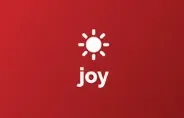
- Emotion word
A plain-language label — the vocabulary the client reaches for.
- Icon
A quick visual anchor that makes the card recognizable at a glance.
- Color = energy level
Warm colors (red, orange) mark high-activation feelings; cool colors (blue, gray) mark low-energy states.
How the 60 cards are organized
The deck splits into two halves, each spanning the energy spectrum from high activation to low:
- PLEASANT EMOTIONS (30) — from High Energy (enthusiasm, joy, pride, inspired) through Warm Connection (love, happiness, hope) and Open Mindset (curious, determined, confidence, courage) to Inner Peace (gratitude, calm, relaxed, peaceful).
- UNPLEASANT EMOTIONS (30) — from High Activation (shock, anger, upset) through Inner Tension (fear, stress, frustration, disappointment) and Social Withdrawal (shame, guilt, loneliness, sadness) to Low Energy (despair, indifference, boredom, powerless).
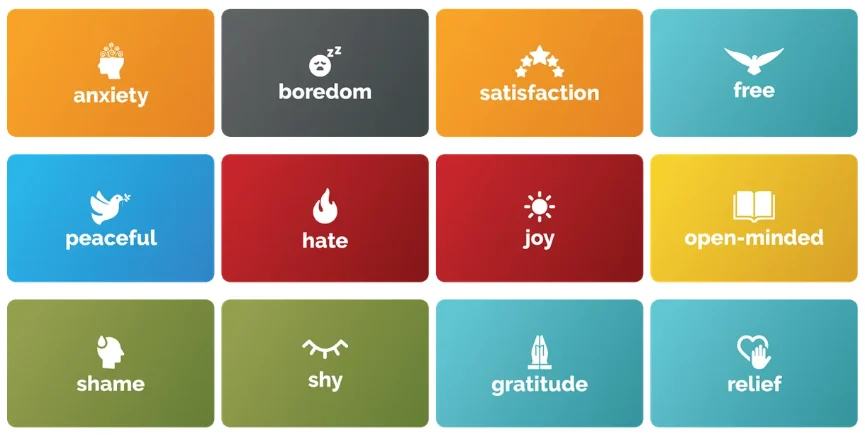
The list is deliberately not exhaustive — it covers the emotions that matter most in everyday coaching, and clients can always name more. The color system lets a client quickly locate where they are on the emotional spectrum before they even have the word.
Psychological grounding
The cards are based on Daniel Goleman's emotional intelligence model, which organizes EI into four domains. The deck supports work in all four — from naming feelings and observing self-talk, through active listening, to communicating the needs behind an emotion.
Self-awareness
Recognizing your own emotions as they arise.
Self-management
Handling those emotions effectively rather than being flooded.
Social awareness
Reading and understanding the emotions of others.
Relationship management
Using emotional understanding to build strong connections.
Why does naming feelings matter so much? Psychologist Lisa Feldman Barrett's research shows that people who make fine-grained distinctions between their emotions — she calls it emotional granularity — handle difficult situations more effectively, build stronger relationships and experience greater well-being. The shift from "I feel bad" to "I feel lonely" is not just a language upgrade: the prefrontal cortex activates, the amygdala calms down, and the client moves from being flooded to thinking clearly.
Name it to tame it
Neuroscientist Matthew Lieberman's phrase for what happens when you label a specific emotion: the amygdala settles and clear thinking returns. Specificity also makes issues actionable — "disappointed" points to a gap between expectation and reality, "resentful" to a crossed boundary, "lonely" to an unmet need for connection, "anxious" to something unpredictable that calls for restored agency.
The color-coding follows the dimensional view of emotion (Russell's circumplex): every emotion can be located by its valence (pleasant–unpleasant) and its arousal (high–low activation). Deliberately, the cards say "pleasant" and "unpleasant" rather than "good" and "bad" — pleasant emotions signal that needs are being satisfied, unpleasant ones that needs are unmet. Treated as data rather than obstacles, emotions turn the conversation from "how do I get rid of this feeling" into "what is this feeling telling me I need."
Further reading
- Lieberman, M. D., et al. (2007). Putting Feelings Into Words: Affect Labeling Disrupts Amygdala Activity. Psychological Science — the neuroscience behind "name it to tame it."
- Barrett, L. F. (2004). Feelings or Words? Understanding the Content in Self-Report Ratings of Experienced Emotion. Journal of Personality and Social Psychology — the research on emotional granularity (open access).
- Russell, J. A. (1980). A Circumplex Model of Affect. Journal of Personality and Social Psychology — the valence/arousal model behind the cards' color-coding.
- Goleman, D. (1995). Emotional Intelligence — the popular framework that anchors the tool.