Beliefs Cards
Identify and shift limiting beliefs with 60 cards across five Schema-Therapy-inspired domains.
Quick Facts
- 60 cards in five domains inspired by Schema Therapy — each card names one internalized belief.
- Card anatomy: DOMAIN in capitals, an icon, the belief statement, and a domain color for quick sorting.
- Limiting beliefs form early as protection, then run as automatic thought patterns into adulthood.
- Session arc: surface familiar beliefs → sort by intensity → question their validity → reframe.
- Reframing moves: Flip the Script, Reverse Roles, Turn Inward — or Needs-First (NVC).
The beliefs cards surface a limiting belief, examine it, and reframe it with your client — all on one shared board. A typical session follows a simple arc:
How to use this tool
Open the beliefs cards tool
If you sense that beliefs are at the core of the client's issue, open the beliefs cards using the Word Cards tool. All 60 beliefs cards are instantly available, organized by their five emotional domains.
Client selects beliefs
Your client browses through all 60 cards at their own pace, filtering by domain or viewing all. Beliefs that resonate are selected with a click and highlighted.
Facilitate reflection
Selected cards appear on your shared whiteboard. Guide your client to sort them by intensity and relevance — clustering beliefs by domain can reveal patterns, and the spatial arrangement shows which beliefs feel most deeply rooted.
Guide the reframe
A belief starts to loosen once it meets a different perspective. Use annotation tools to explore each belief: Where did it come from? What need does it protect? What might be equally true? Help your client craft new, more supportive narratives right on the whiteboard.
For a full coaching arc across several sessions, work in three phases: Recognize & Surface (sort into Deeply True / Somewhat Familiar / Not Sure, narrow to a personal top 3), Question & Relativize (test validity with targeted questions — is it a fact or a feeling, where does it come from, has it ever proven false?), and Transform & Anchor (craft a short, believable new formulation — not the extreme opposite — collect counterarguments, speak it aloud, and practice it in daily life).
Card anatomy
Each card names one internalized belief and carries the cues that let a client sort it at a glance.
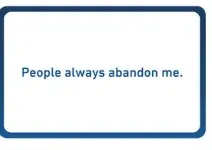
- Belief statement
A first-person sentence naming one internalized belief — the words the client recognizes as their own.
- Domain color = border
A color-coded border marks which of the five emotional domains the belief belongs to, so cards sort themselves as they appear.
- Icon
A visual anchor that makes each card recognizable at a glance.
The five domains
The 60 cards are grouped into five domains, each a core emotional theme rooted in unmet needs. The structure is inspired by Schema Therapy, which explores how early life experiences form deep, recurring belief patterns.
Feeling Unseen
Beliefs that often form where emotional needs are unmet. Clients may struggle to feel worthy of love or expect others to abandon, judge, or overlook them.
Doubting Myself
Beliefs formed where independence was discouraged or criticized. Clients may doubt their ability to cope, make decisions, or succeed on their own.
Criticizing Thoughts
Beliefs tied to the Inner Critic, developed where emotions were minimized and mistakes met harsh judgment. Clients may suppress spontaneity, vulnerability, or pleasure to feel safe.
Demanding Exceptions
Beliefs arising where rules were unclear, consequences inconsistent, or indulgence frequent. Clients may find it difficult to manage impulses or respect limits.
Pleasing Others
Beliefs rooted where love or approval felt earned rather than freely given. Clients may believe their worth depends on meeting others' needs or avoiding conflict.
Psychological grounding
Beliefs are core ideas we have come to accept as true, formed and evolving over a lifetime through our surroundings and relationships. Limiting beliefs often form early as adaptive, protective responses — then become automatic thought patterns that shape perception and behavior into adulthood, frequently without our awareness.
The iceberg model explains why they are hard to spot: only behaviors are visible above the surface. Beneath them lie thoughts, emotions, and unmet needs; deeper still are the beliefs and early experiences that give rise to everything above. Exploring these hidden layers reveals the roots of a client's patterns.
Beliefs are deeply rooted, but they are not facts — they are subjective interpretations, and the more a thought is repeated, the more it is believed. That is also the good news: bringing a belief to light lets a client question whether it still reflects who they are today and reframe it toward something more empowering, aligned with their current needs, values, and goals.
When a belief resists, go Needs-First
When a belief will not budge under direct questioning, uncover the unmet need beneath it and rewrite it as a need-based truth rather than a judgment. Inspired by Nonviolent Communication, "Harmony is more important than conflict" becomes "I can speak up for myself and others to make things more fair."
Further reading
- Rational Emotive Behavior Therapy (REBT) — Albert Ellis's model of irrational, self-limiting beliefs and the A-B-C method of disputing and reframing them.
- Aaron T. Beck and the cognitive model — the founder of cognitive therapy on how core beliefs, not situations, drive our reactions.
- Beck, J. S., & Fleming, S. (2021). A Brief History of Aaron T. Beck and Cognitive Behavior Therapy. Clinical Psychology in Europe — a scholarly overview of cognitive therapy and core beliefs (open access).